
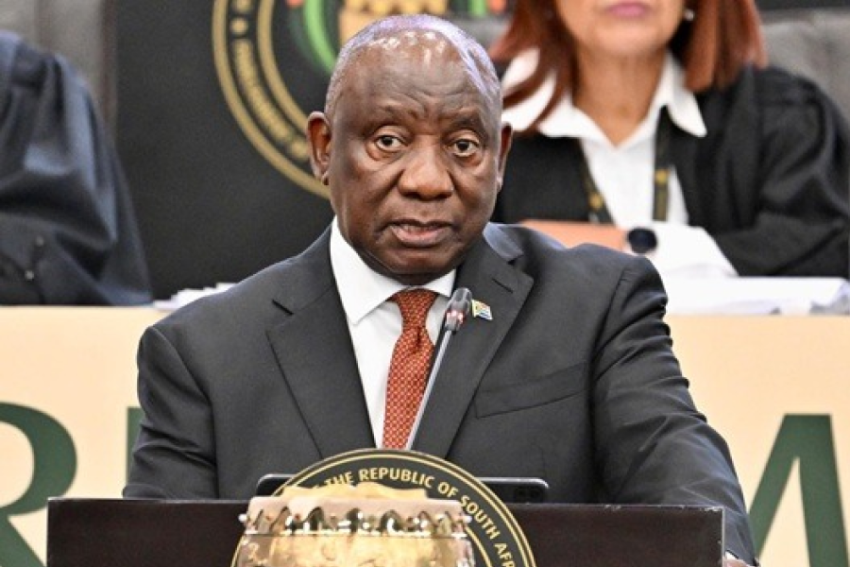
President Cyril Ramaphosa has warned that the escalating conflict in the Middle East and the resulting global oil crisis threaten to undermine South Africa’s fragile economic recovery, increase the cost of living and slow job creation efforts.
Delivering the Presidency’s 2026/27 Budget Vote in the National Assembly on Tuesday, Ramaphosa said recent gains in stabilising inflation and rebuilding investor confidence were now facing fresh external threats.
“The attack by the United States and Israel on Iran and the conflict that has now engulfed much of the region has set off a global oil crisis,” he told MPs.
“The effects of the surge in oil prices and of other critical supplies like fertiliser are likely to undermine much of the progress we had made in bringing down inflation and the cost of living.”
Ramaphosa said the developments, combined with wider disruptions to the global economy, were expected to slow economic growth and hamper government’s efforts to create jobs.
“We should anticipate that conditions will be difficult for the next while,” he said.
The warning comes as South Africans face mounting cost-of-living pressures with rising food prices, electricity costs, fuel prices and borrowing costs placing further strain on household budgets.
South Africa continues to grapple with persistently high unemployment and weak economic growth, despite what the president described as signs of improvement in key economic indicators.
Ramaphosa also pointed to improved public finances, stronger tax collection, stabilising debt levels and recent upgrades to South Africa’s credit outlook by international ratings agencies as evidence that reforms were beginning to yield results.
He also highlighted investment commitments secured through government’s investment drive.
“In March we held a successful sixth South Africa Investment Conference, where we secured pledges in excess of R890 billion in industries across the economy.”
According to the president, economic growth remains government’s foremost priority because it is essential for creating jobs and expanding opportunities.
“We have embarked on the largest infrastructure build in South Africa’s history,” he said.
“Over the next three years, the state will be investing R1 trillion in building and refurbishing roads, dams, schools, hospitals and clinics, as well as energy, logistics and transportation infrastructure.”
Ramaphosa further touted progress in ending load shedding, improving rail and port performance, increasing agricultural exports and growing tourism arrivals.
However, he acknowledged that the latest labour market figures painted a more concerning picture.
“These developments are unfolding as the latest employment figures from Stats SA show a decline in employment in the last quarter,” he said.
“We must still be deeply concerned about the decline in employment, because it is about people’s lives and livelihoods.”
Beyond economic growth, Ramaphosa used the budget vote to outline government’s broader priorities, including fighting corruption, tackling crime, addressing illegal immigration, resolving the country’s water crisis and reforming local government.
He reiterated government’s commitment to implementing the recommendations of the State Capture Commission and said recoveries linked to corruption investigations now exceeded R17 billion.
“There will be no tolerance for corruption, regardless of position, status or political affiliation,” he said.
The president also announced that government was intensifying efforts to address illegal immigration through stronger border management, workplace inspections and prosecutions against employers who violate labour laws.
“We have seen how illegal immigration can put pressure on our public services and undermine our efforts to create decent work,” he said.
On service delivery, Ramaphosa identified failing municipalities and water shortages as among government’s most urgent challenges.
“The true test of government is not what happens at the Union Buildings or in the Houses of Parliament,” he said.
“The true test is whether water flows from a tap, whether a streetlight works, whether refuse is collected, whether a road is maintained and whether a community feels safe.”
Opposition parties, however, remained unconvinced.
Representing the uMkhonto weSizwe Party, Khanyisile Litchfield Tshabalala said her party could not support what she described as an economic programme rooted in neoliberal policies.
“If you really want us to affirm this budget with a proviso that it will grow the economy, throw off the yoke of neoliberalism,” she told the House.
She argued that government remained overly reliant on foreign investment and macroeconomic indicators that did not reflect the lived reality of ordinary South Africans.
“The cost of living is high and it’s escalating,” she said.
Tshabalala further criticised government over unemployment, infrastructure deterioration and water failures, arguing that communities had seen little improvement during Ramaphosa’s tenure.
The Economic Freedom Fighters (EFF) also rejected the Presidency’s budget, with MP Mogamad Nazier Paulsen accusing the administration of inconsistency and poor implementation.
Paulsen highlighted what he described as contradictions between the Presidency’s strategic plans, annual performance plans and budget documents.
“These contradictions mirror the state of your presidency, Mr Ramaphosa. It’s a hot mess,” he said.
He further criticised government for failing to implement a parliamentary resolution calling for the expulsion of Israel’s ambassador to South Africa following the outbreak of the Gaza conflict.
The Democratic Alliance, which supported the budget vote, focused its criticism on failures within the criminal justice system.
DA MP George Michalakis said South Africa’s criminal justice institutions were failing communities despite government’s stated commitment to combating crime.
“Our criminal justice system is failing at almost every level,” Michalakis said.
“The result is a criminal justice chain that is breaking at every link, from investigation, to prosecution, to incarceration, and ultimately into rehabilitation.”
He argued that crime and weaknesses within law enforcement continued to erode public trust in government and democratic institutions.
In addition, Michalakis highlighted the balancing act within the Government of National Unity where coalition partners continue to back key spending plans while maintaining sharp policy disagreements.
Meanwhile , despite opposition criticism, Ramaphosa defended the Presidency’s role as the strategic centre of government responsible for driving implementation, coordinating departments and ensuring that national priorities are translated into measurable outcomes.
“The progress we have made to date is not a product of chance,” he said.
“It is the result of deliberate state action to drive a structural reform agenda across government and with business, labour and other social partners.”