
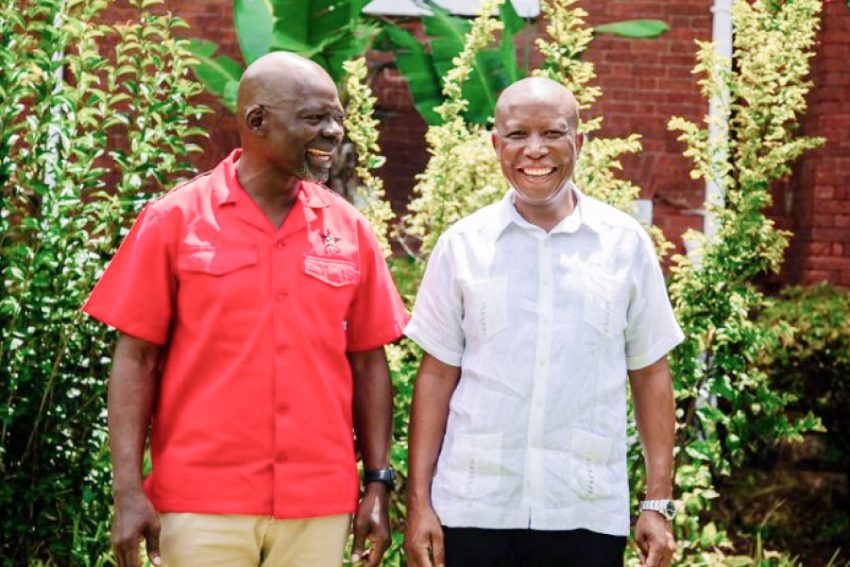
They have traded insults, competed for the same voters and occupied opposite ends of the post-liberation political divide. But on Thursday, the leaders of the South African Communist Party (SACP) and the Economic Freedom Fighters (EFF) sat side by side, spoke from the same platform and delivered a message so aligned it was difficult to tell where one ended, and the other began.
The venue was the Conference of the Left – an ambitious gathering that brought together progressive trade unions, community organisations, women’s formations, youth movements and international delegations from Africa, Latin America, Europe, North America and Asia. The ambition was unity. The message was urgent. And the target was unmistakable: a capitalist system that both leaders argued was devouring the working class and an ANC that had, in their view, chosen the side of capital.
SACP general secretary Solly Mapaila set the tone early. The conference, he said, represented a ‘decisive turn from fragmentation to coordination’ — a gathering convened not for rhetoric or resolution-writing, but for the hard work of building a coordinated left capable of challenging economic power. ‘Our task is not just to manage the crisis of capitalism or to make capitalism more humane,’ Mapaila told delegates. “Our task is to organise for its defeat.”
EFF Commander-in-Chief Julius Malema, whose organisation has spent much of its existence at war with the SACP’s political allies, arrived with equal conviction. Left unity, he argued, was no longer optional. It was, in his words, a “civilisational necessity” — the only viable response to a system he described as one that “produces abundance for a minority precisely through the organised deprivation of the majority.”
If there was a single point at which the two leaders’ arguments fused most completely, it was their condemnation of the ANC’s decision to govern alongside the DA in the Government of National Unity (GNU).
Malema described the partnership as a “profound ideological revelation”, arguing that it stripped the ANC of any remaining credibility on transformation.
“One cannot credibly claim commitment to radical transformation while governing alongside forces historically dedicated to defending white monopoly capital, privatisation, and market fundamentalism,” he said.
Mapaila approached the same conclusion from a different direction. He did not name the DA, but his critique of the economic trajectory under the current government was unambiguous. He slammed the South African Reserve Bank’s recent 25 basis point interest rate increase as a “reactionary” decision taken in the interests of capital, not workers.
He warned against what he called the “false choice between corruption and privatisation”, arguing that collapsing public institutions did not justify handing strategic infrastructure over to “private profiteers”.
Both leaders anchored their arguments in the lived reality of South Africa’s unemployment crisis. Malema cited official unemployment at above 32%, expanded unemployment above 43%, and youth unemployment at a “catastrophic” 60%. Mapaila drew on Statistics South Africa’s quarterly labour force survey, placing expanded unemployment at 33.7%.
Malema said behind these figures lies a profound human tragedy,” Mapaila said, “created and reproduced by an economic system that retrenches workers to concentrate wealth in the hands of a tiny minority.”
Mapaila also trained his focus on South Africa’s working-class women, who he described as the “shock absorbers” of neoliberal restructuring — left to carry the weight of unpaid care work and shrinking household incomes as the state retreated from its social responsibilities.
Despite the remarkable convergence on display, both leaders were deliberate in drawing a distinction between solidarity and absorption. Participating organisations would retain their independence, Mapaila said.
“We are not going here to dissolve our independent political organisations. We are creating a platform of common coordination of the working-class agenda.”
Malema reinforced the point, calling for ideological discipline and rejecting what he characterised as the ego-driven sectarianism that had long weakened the left’s ability to translate analysis into mass mobilisation.
The ANC and Saftu were two notable absentees, as they both declined the invitation to participate in the conference. The South African Federation of Trade Unions (Saftu) did not attend. Mapaila disclosed that bilateral talks had taken place and that Saftu had agreed to engage after the conference — a sign that the process of unification remains incomplete.
The conference is expected to produce a campaign-based programme focused on working-class liberation, opposing privatisation and resisting what both leaders described as a rising authoritarian tide globally, driven by the United States and its allies.