
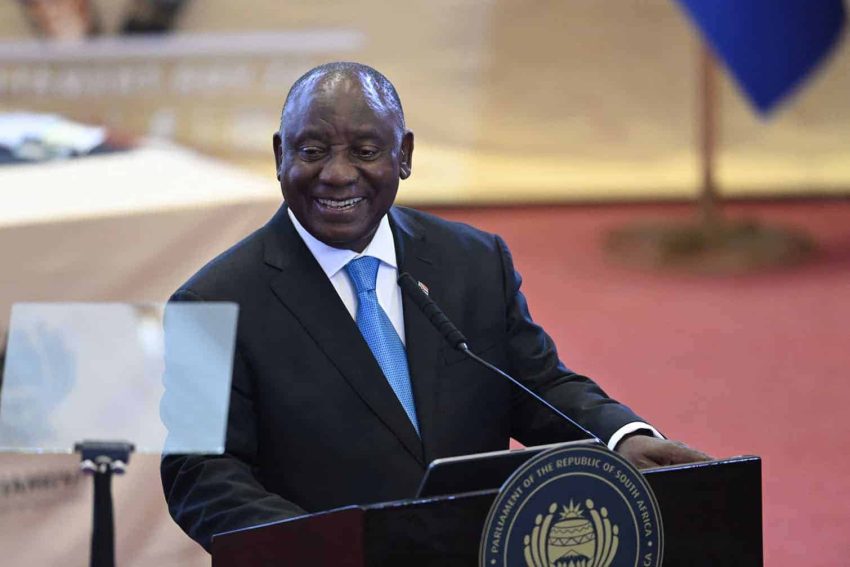
President Cyril Ramaphosa’s plan to revamp municipalities has come under scrutiny.
During his State of the Nation Address (Sona) on Thursday, he said the government is continuing with consultations on the white paper on local government. The aim of this white paper is to make municipalities “modern” and “fit for purpose”, ensuring that residents can access government services without much hassle.
The paper also seeks to review the funding model for municipalities, as some struggle to collect revenue and, in turn, fail to deliver adequate service delivery.
“Learning from our experience over the past 30 years, we will, in the coming months, finalise a revised white paper on local government. This will provide solutions for an effective local government system. The white paper will reimagine how local government works.
“The current system is too complex and fragmented, expecting even small and weak municipalities to take on many responsibilities,” he said.
Ramaphosa’s remarks come during an election year and at a time where many municipalities are failing to deliver basic services to residents. He came under fire last year for suggesting that municipalities controlled by the DA are run better. He has since clarified what he meant to say.
ALSO READ: ‘We must fix local government’: Ramaphosa’s call is necessary, Salga says
Is it anything new? Will it work?
Despite Ramaphosa presenting the ‘finalisation’ of the paper as a remedy this week, it is nothing new. The paper was mentioned in his speech last year and has been under discussion since September 2022.
While some wondered whether Ramaphosa had simply brought it into focus to appease national anger at failed service delivery, Theo Neethling, a political analyst, added that the president’s plan was vague.
“Sound policy formulation is always a necessary starting point. Yet it is in the realm of implementation that political intentions are ultimately tested, and where policy success or failure is determined.
“The ambitions set out in the State of the Nation Address will require three scarce resources: time, funding and administrative competence. South Africa currently enjoys little margin for comfort in any of these areas.
“Moreover, public patience is increasingly thin. Many citizens are no longer prepared to wait for long-term remedies; they expect tangible improvements in the immediate term,” he said.
Neethling said that, against this backdrop, the absence of clear timelines in Ramaphosa’s address is striking.
“Without a sense of urgency and concrete implementation milestones, even well-conceived policy risks remaining aspirational rather than transformative,” he said.
In a statement on Friday, the South African Local Government Association’s president Bheke Stofile said Ramaphosa’s call to fix local government is a necessary one.
“As the sphere closest to communities, municipalities require stable leadership, professionalisation and a sustainable funding model if they are to fulfil their constitutional mandate,” he said.
“The president’s acknowledgement of local government challenges aligns with Salga’s long-standing position that municipalities struggle under the weight of unfunded mandates, governance instability, ageing infrastructure and insufficient capacity,” he added.
NOW READ: Sona: SA army to march into Cape Town and parts of Gauteng, says Ramaphosa
Support Local Journalism
Add The Citizen as a Preferred Source on Google and follow us on Google News to see more of our trusted reporting in Google News and Top Stories.