
Farmers face strict limitations in protecting their livestock because foot-and-mouth disease is classified as a controlled animal disease under South African law.
The foot-and-mouth disease (FMD) is not a new challenge in South Africa; many politicians who have led the Department of Agriculture could not solve it, but having it declared as a national disaster has changed everything.
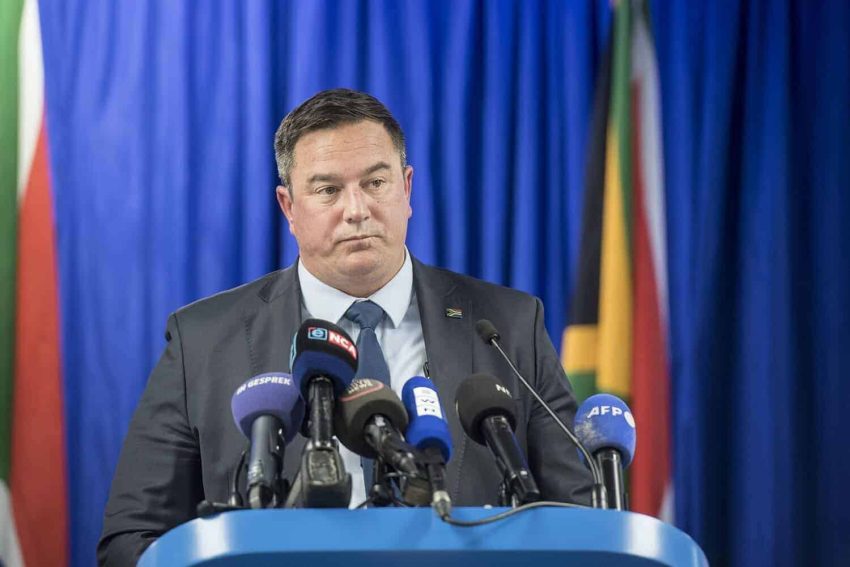
Now all eyes are on Minister John Steenhuisen to see how he will weather this storm. Like many other politicians, if he cannot curb the spread of the disease, nothing will happen to him or his career; however, he would score some brownie points if he achieved an FMD-free status.
FMD is a highly contagious viral disease that affects cloven-hoofed animals such as cattle, sheep, goats and pigs. Should nothing effective be done, the virus would have a devastating impact on the country’s economy, not forgetting the livelihood of farmers.
Is Steenhuisen’s strategy the one?
Minister Steenhuisen recently outlined a strategy that will eliminate the disease in the country; however, he said it will take more than 10 years. The strategy includes beginning with stabilisation and consolidation, before moving toward the eventual withdrawal of vaccinations and final recognition of national freedom through vaccination by the World Organisation for Animal Health (WOAH).
The country is divided over the strategy; some have faith in it because the private sector is included, while others question its efficiency. Will this strategy make or break Steenhuisen’s career?
Political analyst Kenneth Kgwadi told The Citizen he believes the strategy is actionable and doable. “I like that they have included crème de la crème from both the public and private sector to provide the technical know-how on the ground and ensure that they achieve FMD-free status in the coming 10 years,” he said.
“It is highly commendable that the minister places a lot of emphasis on running vaccinations, especially in communal zones,” he said, adding that if implemented, it will help curb the spread of the virus.
ALSO READ: Lesufi calls for local FMD vaccines as Gauteng outbreaks surge
Steenhuisen has a lot of work to do
Kgwadi added that a lot of work still needs to be done for the strategy to yield results. “A lot needs to be done as per the strategy, such as monitoring and tracing the movements of animals.”
He said he has faith that something different will happen this time. “We have had this crisis since 2021, and there was absolutely no sense of urgency on the side of government.
“Having a strategy in place is a sign that there are intentions to change the situation on the ground. It is now up to members of the task team to ensure that what is on paper is indeed implemented.”
He added that it does not matter whether he wins or loses the FMD battle. “It will be both personal and political achievements. He has to prove that he is capable and competent to lead a governmental department and the second-biggest political party in the country.”
Former minister of Agriculture, Thoko Didiza, is one of the leaders who could not solve the disease; however, she has done some commendable work during her tenure. Should Steenhuisen find a solution, it will give him a status within parliament and Cabinet.
Transparency?
One issue people usually have with government is transparency, and it is no different with the FMD disease.
It is more frustrating when farmers cannot do anything to protect their livestock because the disease is classified as a state-controlled disease under legislation. Meaning the government, in this case, Steenhuisen, dictates how it is controlled and managed.
Dr Lindie von Maltitz (PhD), Agricultural Economics senior lecturer at the University of the Free State (UFS), told the Citizen that both commercial and communal farmers don’t feel adequately informed.
“Farmers and other role players are worried and not receiving timeous information on a regular basis,” she said.
“They are left to their own devices to collect information that is, in many cases, from unreliable sources. In many instances, this leads to irrational decisions, often to their own detriment.”
Is the government doing enough?
Von Maltitz said the number of cases and the rate at which they are multiplying show us that the spread of the disease is not contained.
“A critical aspect that needs to be implemented is regulating movement of all cloven-hooved animals in the country immediately,” she added.
“In other words, temporary road blocks need to be erected strategically where vehicles transporting these animals are stopped, and a health certificate is required declaring the animals as disease-free.
“Without this, the disease will just keep spreading from one area to the next until the entire country is infected.”
Minister refuses recommendations
Von Maltitz said appointing the FMD Industry Coordination was a step in the right direction, but many have asked, “Why only now?”
Allegations have been made that Steenhuisen was ignoring advice from previous task teams, which raises eyebrows, given that progress in curbing the spread of the disease would have been made a long time ago.
The Citizen reached out to Minister Steenhuisen’s office about the allegation. No comment had been received by the time of publishing.
“The recommendations of previous task teams were also ignored, which could have saved us a lot of pain and effort,” said Von Maltitz.
“What was particularly disheartening to me was speaking to an agricultural extension officer recently who told me that they do not know what to tell the farmers, what should and should not be done, as they themselves were not adequately informed.”
Shortage of veterinarians
She added that her concern remains with the execution of the strategy. “Currently, we have a critical shortage of veterinarians in our country,” she said.
“Veterinary sectors in developed countries operate with between 30–50 vets per 100 000 people. The South African Veterinary Council suggests 18-25 vets per 100 000 South Africans.
Currently, we are at 6-7 vets per 100 000 people in SA. Farmers need to be involved in executing the strategy for it to be effective.’
Von Maltitz said Steenhuisen has acknowledged that government alone does not have the capacity to effectively implement the strategy.
The private sector has to be involved in the form of private veterinarians and farmers being allowed to assist with vaccination programs. “But even that might be inadequate at the rate the disease is spreading.”
Farmers remain disappointed
Intelact, an international consulting company specialising in benchmarking dairy and beef farmers, told The Citizen that the disease has been around for longer than Steenhuisen’s time as a minister.
“Unfortunately, Steenhuisen inherited a poison cup that has been heading for failure for far longer than he has been in power,” said Emma Kean, beef team lead and a dairy consultant.
“Having said that, the farming community has been (in my experience) extremely disappointed in Steenhuisen’s response time and decision-making processes through this foot and mouth crisis.
“Things that should have happened a year or six months ago have only just happened this month or will only happen in a few months from now.”
ALSO READ: Win for farmers as court orders Steenhuisen to form new vet council
Farmers will be out of business in 10 years
Kean added that she thinks the strategy came in a little bit too late because in those 10 years, farmers will be out of business and food security will be compromised.
“The only way I see us as a country overcoming this crisis is if the private sector is allowed to get involved in the rollout and administering of vaccines,” she added.
“Farmers vaccinate every animal on their farm for plus-minus nine different diseases every year, let them take it on as another compulsory vaccine like brucellosis and anthrax.
“Farmers need to be compensated for losses, which will stop the illegal movement of animals. Currently, people are selling wherever they can so they can feed their families, pay school fees and keep the bank off their backs.”
Ten-year plan ‘lacks urgency, firm timelines, and a clear mechanism’
Francois Rossouw, CEO of the Southern African Agri Initiative (Saai) told The Citizen a long-term vision is necessary, but a 10-year plan means very little if the immediate crisis is not stabilised.
“South Africa is facing an active, expanding outbreak. Farmers are losing breeding stock, export markets are closed, and biosecurity confidence has collapsed,” he added.
“A long-term strategy can only succeed if it is built on short-term emergency measures that actually work. Right now, the plan lacks urgency, firm timelines, and a clear mechanism to mobilise existing capacity outside the state.
“FMD is no longer a theoretical risk or a future concern. It is a national agricultural emergency. What farmers need now is not reassurance, but decisive action, regulatory courage, and the willingness to use all available capacity in the country.”
ALSO READ: Foot-and-mouth disease: Cattle vaccine plan is ‘crisis, not disease control’
Time is not on our side
Wandile Sihlobo, chief economist at the Agricultural Business Chamber of South Africa (Agbiz) said time is not on anyone’s side, and farmers are losing daily as the disease spread continues to weigh on the industry.
“This compels the Department of Agriculture to move much more quickly in permitting imports and allowing farmers to use them,” he said.
“This also means the department must consider importing vaccines from a variety of suppliers, and not rely mainly on Botswana. One other supplier that some in the industry have highlighted is Turkey.
“The dairy farmers in the Midlands region of KwaZulu-Natal and other parts of the country have shared the devastating pictures of the challenge the disease is causing in their stock. KwaZulu-Natal and the Eastern Cape are the major dairy-producing areas of South Africa. If these regions continue to struggle with severe FMD, it also raises concerns for the South African dairy industry.”
Alternative measures?
Other industry players have given measures that can be implemented to curb the spread of the disease.
Rossouw from Saai recommends:
- Immediate regulatory amendments to allow private-sector vaccine procurement, storage, and administration under controlled conditions.
- Decentralised vaccination execution, using private veterinarians to rapidly increase coverage where outbreaks are active.
- Transparent vaccine supply reporting, including confirmed quantities, timelines, and regional allocation.
Von Maltitz from UFS recommends:
- Declare a state of disaster, and involve the South African National Defence Force to set up road blocks as soon as possible.
- Install and enforce a national traceability system to speed up vaccine importation. “To date, about two million animals have been vaccinated. The national herd is estimated at 14 million. One dose of the vaccine is not enough; a booster is required.”
- The current legislation of placing infected farms under a 12-month quarantine is not an incentive for farmers to report the outbreaks.
- In Argentina, the government didn’t try to do it alone. They empowered local farmer-led foundations to assist, implemented a standstill for a couple of weeks until the vaccination programme was well underway, and used oil-based vaccines, which South Africa is now also planning to import.
Most importantly, the farming community wants the government to compensate for the loss it has endured. “The state has cost our industry billions due to lack of urgency, and they should be held liable for that,” said Kean.
A comment from Steenhuisen’s office will be published once it is received.