
South Africa’s broadband access market is expected to reach R82.8-billion in revenue by 2029, with 3.7 million new active subscriptions, according to the latest SA Broadband Report from ICT analyst firm BMIT.
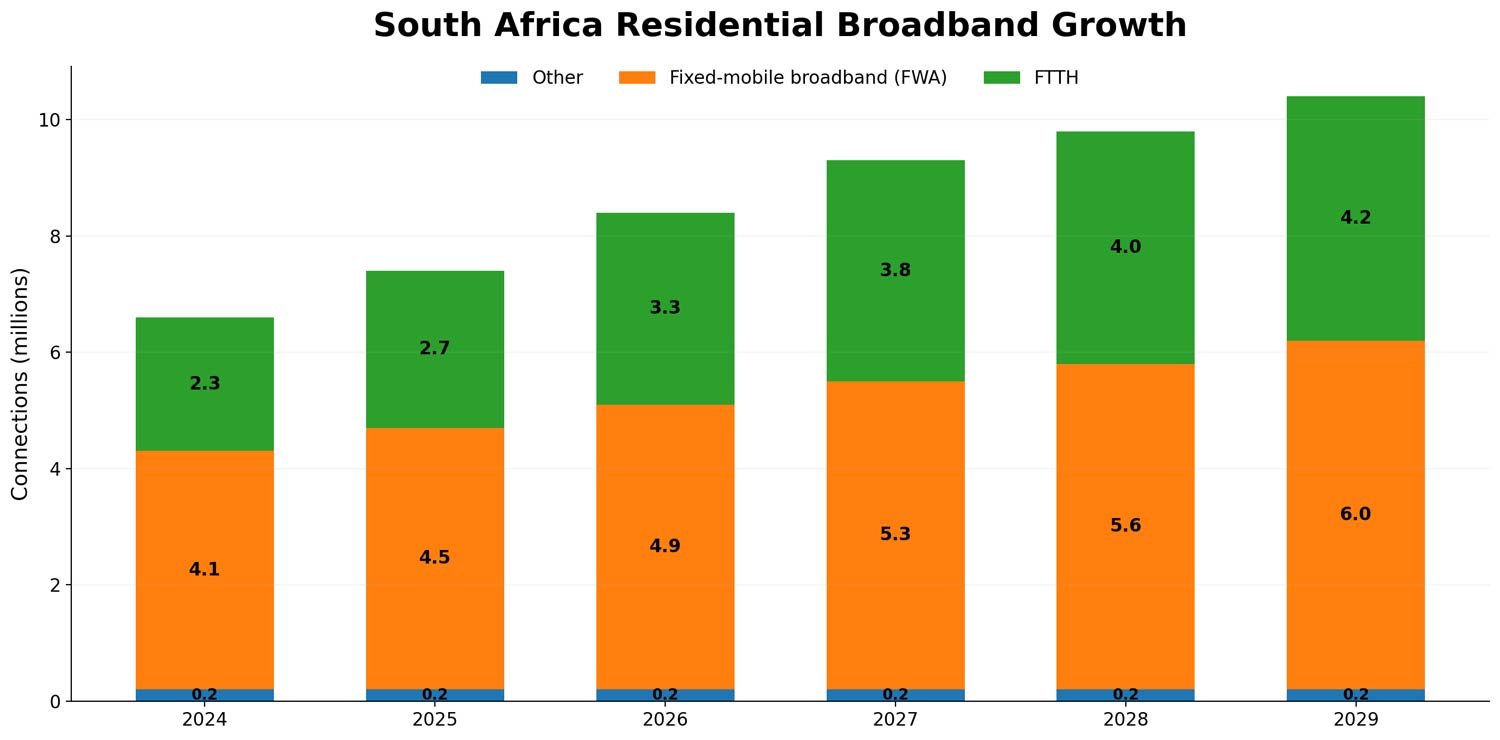
The headline growth rate – a compound annual growth rate of 8.6% – is driven overwhelmingly by the residential market, where both fibre-to-the-home and fixed-mobile broadband continue to see strong uptake.
The most striking finding, however, is the speed at which 5G is eating the fixed-wireless access (FWA) market.
BMIT predicts that 5G will account for 67% of all residential FWA connections by 2029, up from 35% in 2024, as MTN, Vodacom, Rain and Telkom roll out coverage and offer attractively priced, quasi-uncapped packages.
Fibre-to-the-home deployments slowed between 2023 and 2024 after several years of aggressive expansion, but BMIT expects the pace to pick up again as operators push into lower-tier urban areas.
This will be boosted by the recent acquisition by Vodacom of a co-controlling stake in Vumatel parent Maziv. The research firm forecasts residential fibre connections to grow at a CAGR of 12.8% up to 2029.
Lower tier
That expansion into new market segments is critical. As of mid-2025, fewer than 30% of South African homes had fibre passing them in the street, and Icasa data showed the country had 2.47 million home fibre connections by last year.
The growth runway may be long, but the economics of reaching lower-income households remain challenging – and fibre operators will increasingly compete with 5G FWA for the same customers.
BMIT MD Chris Geerdts said in a statement that the broadband access market “continues to offer opportunity in the mid-term, particularly for those operators with a business model suited to deployment to lower-tier households”.
Read: South Africa’s 5G boom is bypassing rural areas: Icasa
However, BMIT’s forecast of a growing, R83-billion market sits in tension with a separate report released by the Development Bank of Southern Africa last week, which warned that South Africa needs between R108-billion and R142-billion in cumulative investment by 2035 just to connect all households to 100Mbit/s broadband.
The DBSA’s South Africa Digital Infrastructure Investment Study found that while 98% of the population has 4G coverage, actual usage remains far lower – with affordability, not availability, the binding constraint. A basic smartphone costs more than 16% of the universal basic minimum monthly wage, and most South Africans still rely on prepaid data bundles rather than fixed broadband.
In other words, the market BMIT is measuring is growing healthily – but it is a market that still excludes the majority of the population.
Of course, if the current regulatory impasse over licensing is resolved, satellite broadband could reshape the competitive picture – particularly in rural areas where neither fibre nor 5G FWA can make the business case work.
Read: SA finally has a broadband map — and it reveals where the gaps are
Starlink remains locked out of the South African market by an unresolved licensing and empowerment standoff. For now, though, the near-term growth story belongs to 5G and fibre. – (c) 2026 NewsCentral Media
Get breaking news from TechCentral on WhatsApp. Sign up here.